
Lately, I have joked with friends that I seem to be living on a Hallmark movie set. Over the last few weeks, a quiet but beautiful phenomenon has been unfolding right in my front yard as I experience the unexpected somatic benefits of flowers. I have been repeatedly gifted with fresh blossoms by the children in my neighbourhood, turning my everyday surroundings into a soft sanctuary of unexpected kindness.
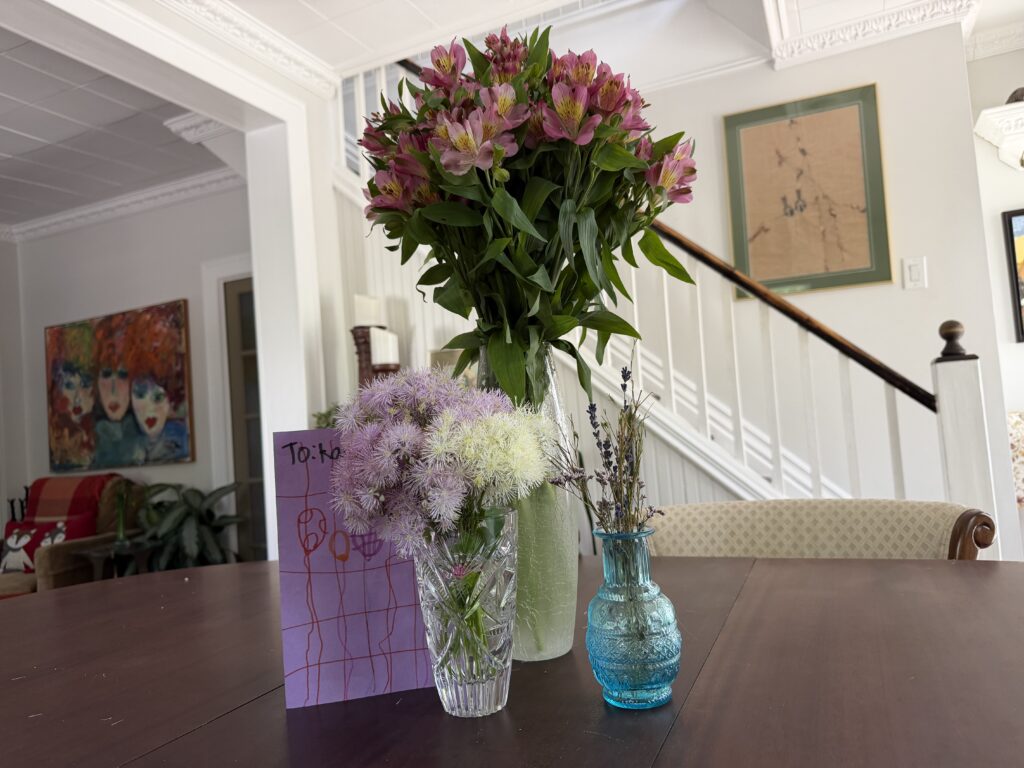
A few weeks ago, right after my sweet fourteen-year-old rescue dog, Toby, passed away, two neighbourhood children approached me in my yard. They handed me a small, turquoise vase filled with fresh sprigs of lavender, hoping to gently soften the immense pain they knew I was feeling. Then, just yesterday, a darling little girl with her braces sparkling in the sunlight came by. She held a beautiful bouquet of white and lavender wildflowers—so incredibly delicate they appeared to be shivering with each soft, passing breeze. She pressed a lovely handmade card into my hand, and in it were the words she’d written with her grade 4 penmanship: “To Katherine, you’re so nice. I’m glad you’re here.”
Even as I write this, sitting on my dining room table is a stunning arrangement of mauve Alstroemeria—my absolute favourite flowers—brought home to me by the loving man in my life.
Amidst the heavy, suffocating silence that so often follows a major loss, these simple gifts have left me wondering: why do these fragile, fleeting things hold such immense power over our well-being? What are the actual somatic benefits of flowers when our hearts are broken?
What struck me wasn’t simply the beauty of the flowers themselves, but the way my body responded to them—a softened breath, a moment of presence, a brief easing of the heaviness grief can place on the nervous system.
1. Calming the Guarded Body: The Somatic Benefits of Flowers
When we experience deep grief or trauma, the immediate survival mechanism of our nervous system is to lock down. We become hyper-vigilant, and our sensory world can feel overwhelming or entirely empty.
One of the primary somatic benefits of flowers is their innate ability to speak directly to our survival brain without using words. Scent, for instance, bypasses the logical parts of our mind entirely. The aroma of the lavender left by the children travels to the limbic system— engaging the brain regions involved in emotion, memory, and stress responses. For many people, pleasant scents can encourage a moment of pause, evoking a sense of comfort, safety, or connection, which makes it easier to soften physical tension and reconnect with the present moment.
2. Visual Grounding and Co-Regulation
Grief can make us feel utterly isolated, forcing us into a painful staring contest with an empty house. Delicate wildflowers act as a profound tool for visual grounding.
Watching those delicate petals shiver in a soft passing breeze gives a highly activated nervous system a safe, neutral anchor to observe. It pulls our focus away from internal distress and grounds us firmly in the current room, onto the current chair, and into the present moment. Furthermore, the human connection attached to these gifts—like a little girl reaching out to share that she is glad you are here—can provide a moment of co-regulation, reminding our bodies that we are tethered to a caring community.
3. Embracing Impermanence and Present Joy
The mauve Alstroemeria on my dining table serves as a beautiful, daily anchor. Flowers are inherently fleeting; they do not last forever.
While a guarded mind might want to reject something that will eventually fade to avoid future pain, allowing ourselves to enjoy a blooming bouquet is a brave act of emotional expansion. It teaches our hearts to hold two realities at once: honouring the deep losses of our past, while remaining open to the small pockets of beauty whispering to us in the present.
If your body and mind are feeling overwhelmed by a season of change or loss, sometimes the most profound healing begins by simply opening the door to the small, delicate gifts the world leaves on your doorstep.
If you are ready to find a supportive, collaborative space to process a heavy season of life and help your nervous system find its steady rhythm again, I invite you to reach out through my contact page to schedule a supportive dialogue session together.
Pingback: The Brave Expansion: Walking Through the Door After Loss - Katherine Fitz Therapy