
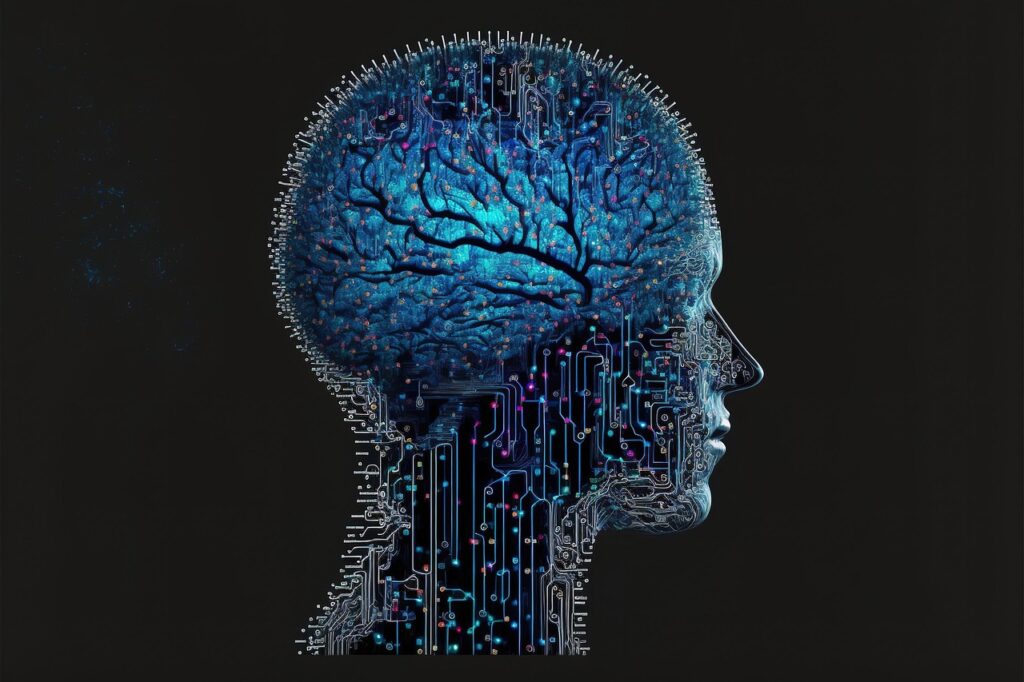
Neuroplasticity refers to the brain’s ability to change and reorganize itself throughout life.
There is a moment many people quietly arrive at.
A moment where something inside begins to feel a little too fixed.
The thought might sound like:
“I’ve always been like this.”
“I can’t seem to change.”
“No matter what I try, I end up back here.”
Underneath those thoughts is often a deeper assumption—that the brain is more rigid than it actually is.
But the brain is not fixed.
It is constantly changing.
And it is changing in response to what we repeat.
This is the foundation of neuroplasticity.
What neuroplasticity actually means (in plain language)
Neuroplasticity simply refers to the brain’s ability to reorganize itself.
It is not a personality trait or a mindset.
It is a biological process.
Your brain is made up of networks of neurons that communicate with one another. When you think, feel, move, or respond in a certain way, those neurons fire together in specific patterns.
And the more a pattern is repeated, the more efficient it becomes.
In simple terms:
What gets used becomes stronger.
What gets used less gradually becomes quieter.
This is not something you consciously control moment by moment. It is happening continuously in the background of everyday life.
Why your brain changes throughout your life
There is a persistent myth that the adult brain becomes “set” at a certain age.
While it is true that early development is a particularly active period of change, the brain continues to adapt throughout life.
It learns.
It adjusts.
It refines patterns based on experience.
This is why people can learn new languages later in life, develop new skills, shift long-held habits, and gradually change emotional responses to familiar situations.
Nothing about this requires becoming a “different person.”
It is the same brain, reorganizing itself in response to repetition and experience.
How neuroplasticity shapes habit formation
Habits are often misunderstood as a lack of discipline or willpower.
But from a neurological perspective, habits are simply efficient patterns.
They tend to follow a simple loop:
- A cue (something triggers the pattern)
- A response (a thought, behaviour, or emotional reaction)
- A reward (a sense of relief, familiarity, or resolution)
Over time, the brain begins to automate this loop because automation reduces effort.
This is important to understand:
The brain does not choose habits based on whether they are helpful or unhelpful.
It chooses them based on familiarity and efficiency.
Which means many of the patterns people struggle with are not “bad habits” in a moral sense—they are simply well-rehearsed ones.
Why repetition matters in neuroplasticity
People often try to change through intensity.
More motivation.
More discipline.
More self-control.
But the brain does not reorganize itself through intensity alone.
It reorganizes through repetition.
A single insight can feel meaningful, but it does not usually create lasting change on its own. The brain learns through repeated experience over time.
This is why change can feel inconsistent. Motivation rises and falls, but repetition is what builds continuity.
In many ways, the question is not:
“How do I force myself to change?”
but rather:
“What am I repeatedly teaching my brain through what I do next?”
The simple principle behind learning in the brain
There is a well-known principle in neuroscience:
Neurons that fire together, wire together.
This means that when certain thoughts, emotions, or behaviours are activated repeatedly at the same time, the connections between them become stronger.
Over time, the brain becomes more likely to follow that same pathway again.
This is how learning happens.
It is also how unlearning becomes possible—not by erasing experience, but by gradually building alternative pathways through repetition.
How hypnotherapy may support the learning process
From a neuroscience perspective, focused attention and internal imagery can influence how the brain engages with patterns of learning.
In clinical hypnotherapy, this may involve guiding a person into a calm, focused state where attention becomes more internal and less distracted by external input.
In that state, individuals may explore new ways of thinking, rehearse alternative responses, or strengthen internal resources such as calm, steadiness, or clarity.
This is not about forcing change.
It is about creating conditions where new patterns can be experienced with greater attention and repetition.
What happens between sessions is just as important. The brain continues learning through daily life—through noticing, pausing, and gradually practicing new responses in real situations.
Why integration is essential for neuroplasticity
Insight alone is not the same as change.
Many people have moments of understanding where something suddenly makes sense, yet find themselves returning to old patterns afterward.
This is not failure.
It is how learning works.
For the brain, change becomes more stable through integration—meaning repeated experience in real-life situations over time.
Sleep, reflection, emotional processing, and repetition all contribute to this process.
Without integration, new insights can remain abstract.
With integration, they become familiar.
And what becomes familiar becomes easier to access.
Change is not a single moment
One of the most important things neuroplasticity shows us is that change is not usually dramatic or immediate.
It is gradual.
Often subtle.
Sometimes almost unnoticeable in the short term.
But over time, small repeated shifts begin to reorganize how the brain responds.
Not through force.
Not through pressure.
But through experience.
Closing reflection
Neuroplasticity does not suggest that change is easy.
But it does suggest that change is possible.
Not because we become someone new, but because the brain continues to adapt to what we repeatedly do, think, and experience.
In that sense, every small repetition matters more than it first appears.
And over time, those repetitions begin to shape something that feels more steady, more supported, and more aligned with how we want to live.
To read more
If you’re interested in exploring these ideas further, you may find it helpful to read some of my related blogs:
- What Happens During a Hypnotherapy Session? A Guide to Clinical Hypnotherapy
- Why We Stay Stuck Even When We Know Better
- The Anatomy of Integration: How Change Becomes Sustainable
- Holding It Together Isn’t the Same as Thriving
- Chronic Pain and the Overprotective Nervous System
Each of these pieces connects, in different ways, to how patterns are learned, reinforced, and gradually changed over time.
Learn more (research and references)
If you’d like to explore the science behind neuroplasticity further, these sources offer helpful context:
- Doidge, N. (2007). The brain that changes itself. Penguin Random House.
https://www.penguinrandomhouse.com/books/294184/the-brain-that-changes-itself-by-norman-doidge/ - Kolb, B., & Gibb, R. (2014). Searching for the principles of brain plasticity and behavior. Cortex.
https://www.sciencedirect.com/science/article/pii/S0010945214000125 - National Institute of Neurological Disorders and Stroke (NINDS): https://www.ninds.nih.gov
- American Psychological Association (APA): https://www.apa.org
Disclaimer
The content on this website is provided for educational and informational purposes only. I offer clinical hypnotherapy and supportive wellness services designed to complement overall well-being. I do not provide medical diagnoses, psychological assessments, psychotherapy, or treatment for medical conditions, in accordance with the standards of practice and applicable regulations including Loi 21 in Quebec.
Pingback: The Window of Tolerance: Why Sometimes We Can’t Think Clearly - Katherine Fitz Therapy
Pingback: The Science of Visualization: Why Your Brain Responds to Imagined Experience - Katherine Fitz Therapy